

Dear Students,
السلام عليكم ورحمة الله وبركاته
I welcome you with the very words that the Prophet Muhammad (peace be upon him) used to greet those who came to him seeking knowledge: “Welcome, O seeker of knowledge.”
Welcome to the vast realms of learning and the gardens of Paradise. You have embarked upon the noblest of quests – one worthy of a lifetime’s devotion. Knowledge is so profound that Allah never commanded our Prophet to pray for an increase in anything except it:
“And say, ‘My Lord, increase me in knowledge.’” [Qur’an, 20:114]
To illustrate its immense virtue, Allah, the Almighty, paired His own testimony with that of His angels and the people of knowledge:
“Allah witnesses that there is no deity except Him, and [so do] the angels and those of knowledge.” [Qur’an, 3:18]
He further elevated their status, promising:
“Allah will raise those who have believed among you and those who were given knowledge, by degrees.” [Qur’an, 58:11]
He also bestowed a unique distinction upon those who dedicate themselves to the Book of Allah, as the Prophet (pbuh) said: “The best of you are those who learn the Qur’an and teach it.” (Narrated by Al-Bukhari)
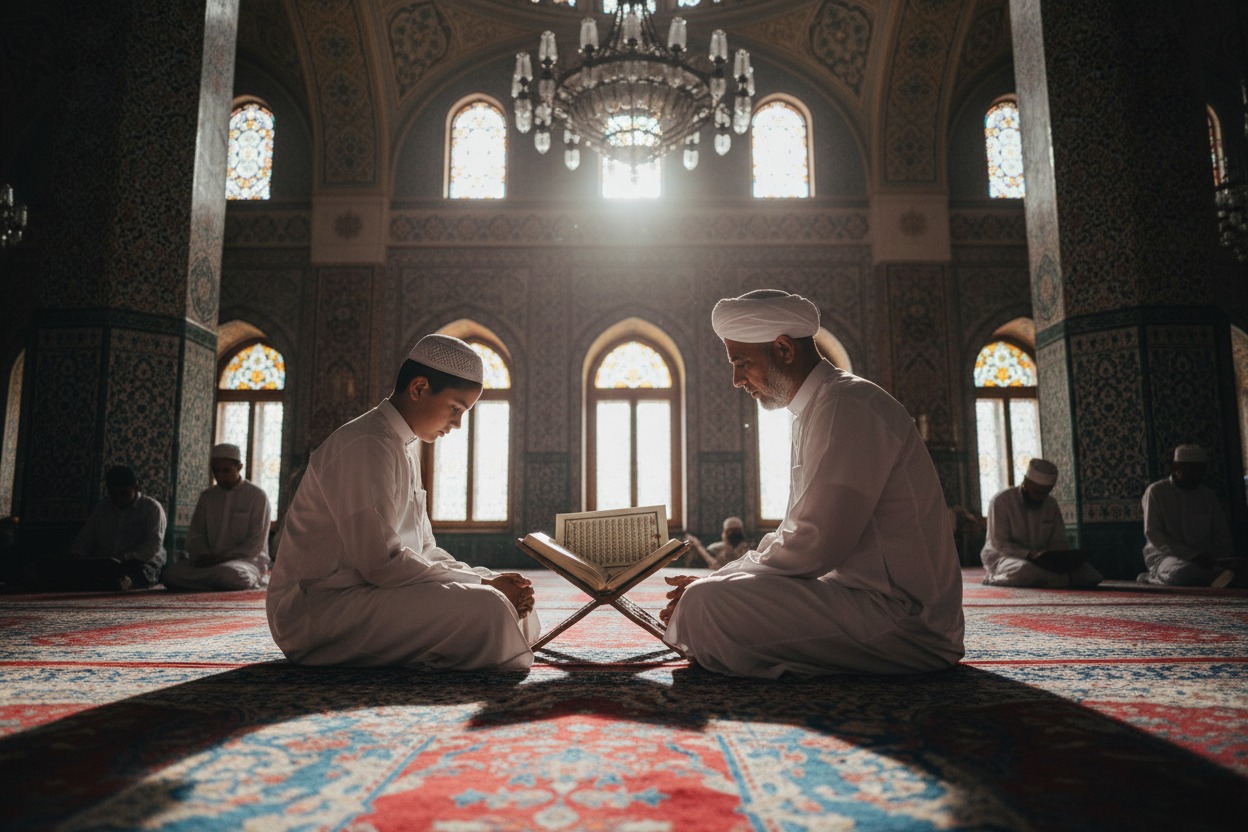
The Fundamental Foundation: Character (Adab)
While the verses and traditions emphasizing the virtues of knowledge are countless, many students overlook a vital cornerstone: the manners and ethics (Adab) of learning. Historically, scholars would master character and etiquette long before diving into the core sciences. Allah Himself praised His Messenger’s character, saying:
“And indeed, you are of a great moral character.” [Qur’an, 68:4]
Furthermore, when our mother Aisha (may Allah be pleased with her) was asked about his character, she beautifully replied: “His character was the Qur’an.” (Narrated by Ahmad)
Therefore, out of reverence for this sacred act of worship – one of the most honourable deeds a person can perform – every student must embody the following virtues. For enhanced clarity and focus, these essential traits are outlined below:
I. The Student’s Etiquette with Themselves
- Sincerity (Ikhlas):
- Purifying the intention to seek knowledge solely for the sake and pleasure of Allah.
- Purity:
- Cultivating and maintaining both outward physical cleanliness and inward spiritual purity.
- Application:
- Striving to consistently practice and implement the knowledge acquired.
- Piety (Taqwa):
- Adhering to the divine command: “And fear Allah. And Allah teaches you.” [Qur’an, 2:282]
II. The Student’s Etiquette with Their Teacher
- Reverence and Respect:
- Holding the teacher in the highest esteem and treating them with profound respect.
- Honorific Speech:
- Addressing them with respectful titles (e.g., “Sheikh”, “Ustadh”) and strictly avoiding the use of their first name or casual terms like “you” or “my brother.”
- Proper Greetings:
- Offering a polite, personalized greeting. In remote or online learning environments, students should send a courteous written request before initiating a call.
- Seeking Permission:
- Always requesting formal permission before commencing the lesson.
- Attentive Listening:
- Demonstrating respect by never interrupting the teacher while they are speaking.
- Graciousness in Feedback:
- Expressing deep gratitude whenever the teacher provides guidance or feedback, using prayers such as: “BarakallahuFeekum” (May Allah bless you) or “JazakumullahuKhayran” (May Allah reward you with goodness).
- Concluding Prayers:
- Ending every educational session by sincerely praying for the teacher: “Jazak Allahu Khayran”.
- Digital Etiquette:
- Ensuring professional boundaries by never disconnecting or hanging up an online session before the teacher does.
A Timeless Lesson in Character
The Qur’anic narrative of the Prophet Moses (Musa) and Al-Khidr offers the greatest lesson in student-teacher etiquette. Despite Moses’s immense virtue and status as a Prophet, when he assumed the role of a student, he spoke with ultimate humility:
“May I follow you on [the condition] that you teach me from what you have been taught sound judgment?”
Al-Khidr replied: “Indeed, with me you will never be able to have patience.”
To which Moses humbly responded: “You will find me, if Allah wills, patient, and I will not disobey you in [any] order.” [Qur’an, 18:66-69]
This exemplary humility represents the standard of how a true student should deport themselves with their mentor.
III. The Student’s Etiquette with Peers
- Faith-Based Fraternity:
- Cultivating strong bonds of brotherhood or sisterhood rooted sincerely in the love of Allah.
- Humility:
- Remaining grounded, approachable, and entirely free from arrogance.
- Collaboration:
- Working together harmoniously and supporting one another throughout the academic journey.
- Mutual Sincere Counsel (Tanasuh):
- Advising and correcting peers with utmost kindness, sincerity, and privacy.
- Purging Malice:
- Actively guarding the heart against envy, jealousy, and pride.
