
As Muslims around the world prepare to celebrate Eid al-Adha, it is worth pausing to ask a question that is rarely raised: are we performing the sacrifice as Islam truly intends it to be performed?
Every year, without fail, videos circulate on social media showing scenes that are difficult to watch — animals dragged violently through streets, slaughter carried out without supervision or skill, carcasses left in unsanitary conditions, and livestock escaping into traffic. These are not isolated incidents. In Turkey alone, over 1,400 people sustained serious injuries during last year’s Eid al-Adha sacrifices, a figure cited by the Turkish Minister of Health, who attributed the cause directly to a lack of expertise. In Dhaka, Bangladesh, more than 300 injuries were recorded in the capital alone during the same period, as reported by the Times of India on June 7, 2025.
These numbers are not merely statistics. They are a sign that something has gone quietly wrong in how Muslims understand and practice one of Islam’s most sacred rites.
What Eid al-Adha Is Really About
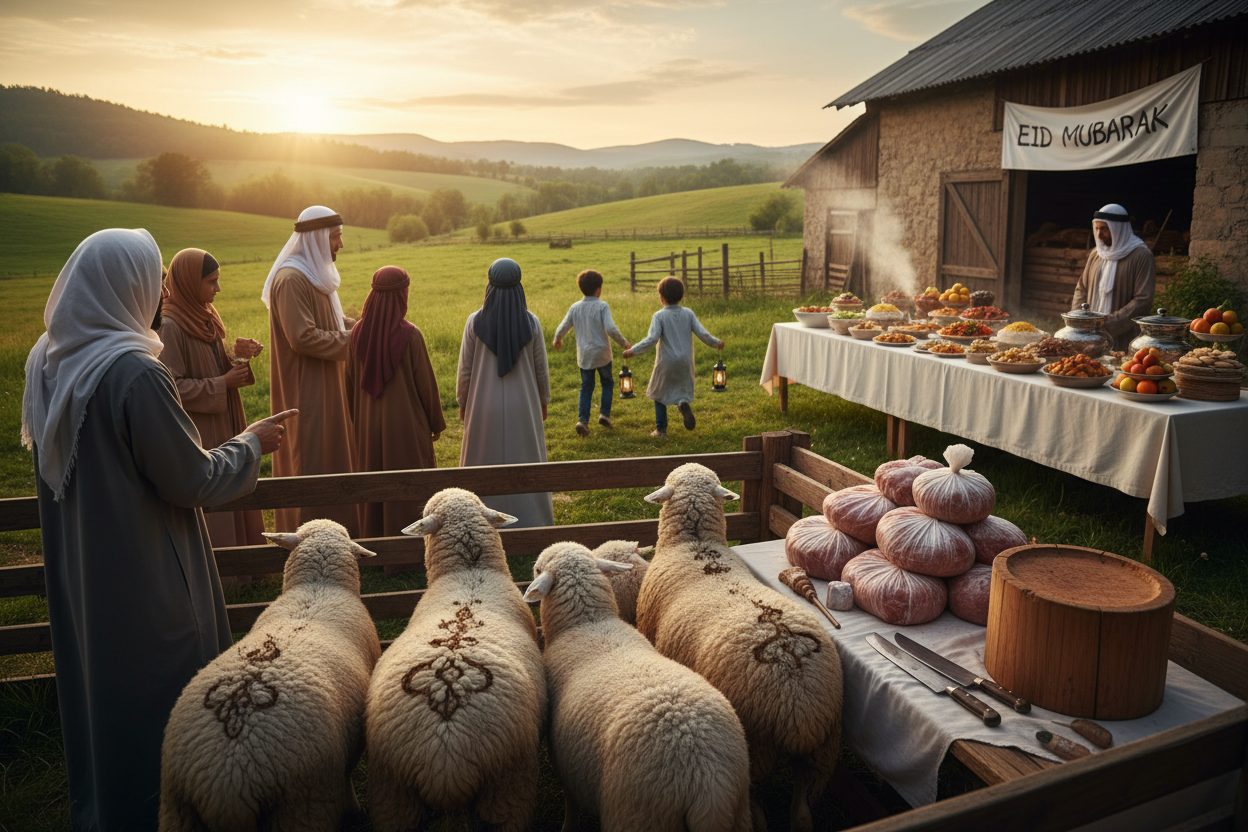
Eid al-Adha is not a celebration of slaughter. It is an act of worship — a conscious drawing near to God through obedience, generosity, and remembrance. The Qur’an is unambiguous on this point:
“It is not their meat nor their blood that reaches Allah, but it is your piety that reaches Him.” Surah al-Hajj, 22:37
The outward act — the animal, the knife, the blood — carries no value in itself. What matters is the intention, the reverence, and the manner in which the act is performed. This is where the concept of Al-Ihsan becomes not merely relevant, but essential.
Understanding Al-Ihsan
The Prophet Muhammad ﷺ said: “Indeed, Allah has prescribed perfection in everything. So when you kill, kill well; and when you slaughter, slaughter well. Let one of you sharpen his blade and spare his animal from suffering.” (Sahih Muslim)
What is striking about this hadith is what the Prophet chose not to say. He did not prescribe a rigid checklist of technical steps. Instead, he invoked a single, comprehensive concept: Ihsan — excellence, perfection, and moral refinement in every act.
The word Ihsan appears thirty-seven times in the Qur’an. Allah commands it, loves those who practice it, and has promised them the greatest of rewards. In the famous Hadith of Gabriel, the Prophet defined it at its highest: “To worship Allah as though you see Him; and if you cannot see Him, know that He sees you.” This is not merely a spiritual aspiration. It is a practical standard that shapes how a Muslim handles every responsibility — including the care of animals entrusted to him on the day of sacrifice.
What Al-Ihsan Demands in Practice
Applying Ihsan to the sacrifice of Eid al-Adha means rethinking the entire process — from the selection of the animal to the distribution of its meat.
The animal must be sound and healthy.
The Prophet ﷺ was explicit: a one-eyed animal, a visibly sick animal, a lame animal, and a severely emaciated animal are all unacceptable for sacrifice. Offering a defective animal is not merely a legal failing — it contradicts the very spirit of excellence that the act of sacrifice is meant to embody.
Animals must be led to slaughter with gentleness.
Umar ibn al-Khattab once saw a man dragging a sheep by its leg and rebuked him sharply: “Woe to you — lead it to its death in a gentle manner.” (Al-Musannaf, 4/493). This is not a minor courtesy. It is a religious obligation.
Animals must be spared psychological distress.
They should not be shown the blade before slaughter, nor should they witness the slaughter of other animals. The Prophet ﷺ once saw a man laying down a sheep while still sharpening his knife and said: “Do you intend to kill it twice? Why did you not sharpen your knife before laying it down?” (Al-Hakim). Each animal deserves to be treated with dignity in an appropriate and private space.
The method of slaughter must be humane.
Methods that cause prolonged or unnecessary suffering — including the use of blunt force, gas, or electricity — fall outside the bounds of Ihsan. Skinning must not begin before death has been fully confirmed. The Qur’an prohibits the consumption of blood poured forth (Surah al-An’am, 6:145), and this prohibition reflects a deeper principle: that even in death, the animal’s dignity must be respected.
Cleanliness is not optional.
The area of slaughter must be clean before, during, and after the act. Blood, waste, and animal remains left unmanaged pose genuine public health risks and contradict Islam’s foundational commitment to purity. Causing preventable harm to a community in the name of worship is itself a violation of the Prophet’s teaching: “There should be neither harming nor reciprocating harm.” (Ahmad)
The sacrifice must remain a pure act of worship.
It must be free from superstition, misuse, or the incorporation of practices that have no basis in Islamic teaching. The Qur’an is clear: “So pray to your Lord and sacrifice to Him.” (Surah al-Kawthar, 108:2)
The distribution of meat is an act of social responsibility.
The Qur’an instructs believers to eat from the sacrifice and feed both the poor and those who do not ask. Many companions, including ‘Ibn Umar, Ibn Mas’ud, and Ibn ‘Abbas, recommended dividing the meat into three equal portions: one for the household, one for relatives and guests, and one for the poor and needy. This threefold division is not merely a tradition — it is an expression of the balance between personal observance and communal solidarity that lies at the heart of Islamic worship.
A Consensus Ignored
It is worth noting that Ihsan in slaughter is not a matter of scholarly debate. The Andalusian jurist Ibn Hazm (d. 456 AH / 1064 CE) recorded that Muslim scholars reached a consensus on its obligation. This is not a peripheral concern. It is a point of agreement across the tradition.
And yet, year after year, the images tell a different story.
The Way Forward
Restoring the ethics of Eid al-Adha requires action at multiple levels.
Governments and religious authorities should regulate sacrifice practices through mandatory veterinary supervision and designate properly equipped slaughter facilities that meet hygiene and animal welfare standards. Mosques, educational institutions, and media platforms must strengthen public awareness of the religious rulings and ethical requirements of sacrifice — not only in the days leading up to Eid, but as part of ongoing religious education.
Communities must take responsibility for discouraging the circulation of distressing or misleading footage that misrepresents Islam. When harmful practices occur, they should be attributed to ignorance — not to Islam itself — and reported to the relevant authorities.
Most importantly, Muslims must reclaim the inner spirit of this day. Eid al-Adha is a moment of nearness to God, of gratitude for the gift of life, of compassion for the poor, and of reverence for every creature placed in our care. The Prophet ﷺ reminded us: “Be merciful to those on earth, and He who is in heaven will show mercy to you.” (Abu Dawud)
The Qur’an closes the verse on sacrifice with a promise reserved for a specific group of people — not those who sacrifice the most animals, or the most expensive ones, but those who practice Ihsan:
“So give glad tidings to those who excel in goodness.” Surah al-Hajj, 22:37
That is the standard Islam sets. It is time we returned to it.
